
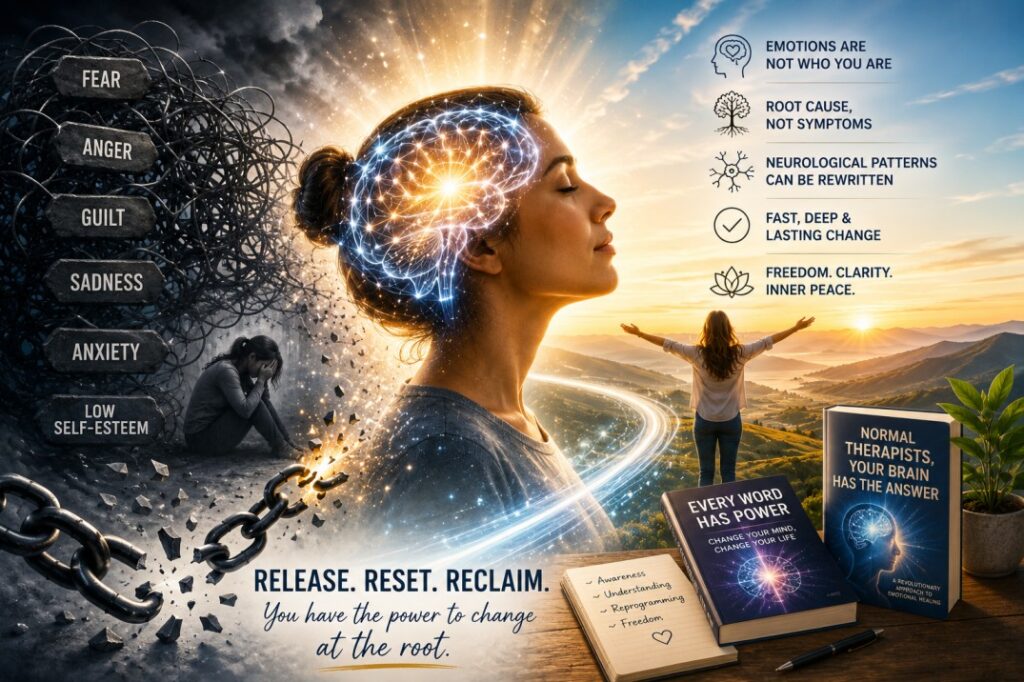
Most people have been taught that emotional healing takes years.
We are told that overcoming anxiety, fear, guilt, anger, low self-esteem, and past trauma requires endless analysis, repeated conversations, and learning to “manage” our emotions.
But what if that belief is wrong?
What if many of the emotional patterns that hold us back are not permanent parts of our identity but simply neurological programs running in the background?
This was the powerful premise behind a fascinating conversation with Dr. Yvonne Oswald, a pioneer in neuroscience, NLP, hypnosis, and human behavioral technology.
Her message is both simple and revolutionary:
You are not your emotions.
And if emotional responses are learned, they can also be unlearned.
The Hidden Programs Running Your Life
Most people believe they consciously control their lives.
The reality is quite different.
Many of our beliefs, behaviors, emotional reactions, and limitations were formed long before we were capable of critically evaluating them.
During childhood, especially before the age of seven, the brain absorbs information without filtering it.
A simple interaction with a parent, teacher, sibling, or authority figure can create unconscious conclusions such as:
- I am not good enough.
- I have to be perfect to be loved.
- My needs don’t matter.
- I must take care of everyone else.
- I am responsible for other people’s feelings.
The child does not question these conclusions.
They simply become part of the operating system.
Years later, these same beliefs continue influencing careers, relationships, confidence, finances, and health.
The challenge is that most people do not realize these programs are running.
They simply assume:
“This is who I am.”
Why Insight Alone Is Not Enough
One of the most important distinctions Dr. Oswald makes is between understanding a problem and changing it.
Many people spend years analyzing their past.
They understand why they feel anxious.
They know where their fear originated.
They can explain every detail of their childhood.
Yet their emotional reactions remain the same.
Why?
Because understanding does not automatically create transformation.
You can understand fear and still feel afraid.
You can understand anxiety and still feel anxious.
You can understand low self-worth and still struggle with confidence.
Real change happens when the underlying neurological pattern changes.
Understanding is valuable.
Transformation is better.
Emotions Are Messages, Not Identity
One of the most liberating ideas from the conversation is that emotions are not who you are.
They are signals.
They are responses.
They are messages.
Many people identify with their emotional state:
- I am anxious.
- I am angry.
- I am depressed.
- I am insecure.
But Dr. Oswald challenges this perspective.
Instead of seeing emotions as identity, see them as information.
The emotion is attempting to communicate something.
It is drawing attention to an unresolved experience, belief, memory, or interpretation.
Once the message has been understood and processed, the emotion no longer needs to remain active.
The problem is that many people spend years treating the symptom while ignoring the source.
The Root Cause Principle
Imagine a weed growing in your garden.
You can cut the leaves.
You can trim the stem.
You can hide it temporarily.
But unless you remove the root, it keeps returning.
Emotional patterns work in much the same way.
Many approaches focus on managing symptoms.
Dr. Oswald’s work focuses on identifying and releasing the root cause.
The root cause is often not the event itself.
It is the meaning assigned to the event.
Two children can experience the same situation and create completely different conclusions about themselves.
The event matters.
But the interpretation often matters more.
Why Anxiety Feels So Powerful
Anxiety has become one of the defining challenges of modern life.
Many people live in a constant state of:
- Worry
- Overthinking
- Anticipation
- Fear of the future
- Fear of failure
- Fear of judgment
Dr. Oswald explains that anxiety differs from emotions such as anger, guilt, sadness, or fear because it is future-focused.
The mind is attempting to predict and prepare for potential problems.
Unfortunately, it often creates problems that never happen.
The result is mental exhaustion.
The body reacts as though danger is present even when nothing threatening exists.
The nervous system remains on high alert.
Many people spend years living in survival mode without realizing it.
The Power of Language
One of Dr. Oswald’s most influential teachings comes from her bestselling book, Every Word Has Power.
Most people underestimate how much language influences thinking.
The words we repeatedly use shape our internal reality.
Consider how often people say:
- No problem.
- Not bad.
- Don’t worry.
- Don’t fail.
- Don’t forget.
The unconscious mind tends to focus on the key image within the phrase.
Instead of focusing on what we don’t want, Dr. Oswald encourages people to consciously focus on what they do want.
This small shift can create significant changes over time.
Your language is constantly programming your mind.
The question is:
Are you programming it intentionally?
Three Practical Practices to
Improve Your Emotional State
1. Create an Accomplishment Journal
Instead of ending each day focused on what you didn’t achieve, write down three things you did well.
They don’t need to be extraordinary.
Small wins matter.
This trains the brain to recognize progress rather than constantly searching for shortcomings.
2. Practice Conscious Breathing
Stress changes the body’s physiology.
Deep breathing helps calm the nervous system and signals safety to the brain.
A simple breathing pattern:
- Inhale for four counts
- Hold for four counts
- Exhale for four counts
- Hold for four counts
Repeat several times.
Small practices create powerful results when repeated consistently.
3. Write a Letter From Your Future Self
Imagine it is one year from today.
Describe everything that has gone right.
Write about:
- Your health
- Your relationships
- Your finances
- Your career
- Your confidence
- Your happiness
Allow yourself to fully experience that future version of your life.
This exercise shifts attention away from fear and toward possibility.
Triggers Are Teachers
One of the most valuable ideas discussed during the interview was how to view emotional triggers.
Most people see triggers as problems.
Dr. Oswald suggests a different perspective.
A trigger is information.
When someone upsets you, disappoints you, or provokes a strong emotional reaction, ask:
“What is this showing me about myself?”
The trigger often points toward an unresolved belief, wound, or pattern.
Rather than resisting the trigger, become curious about it.
Curiosity accelerates growth.
The Real Goal Is Freedom
At its core, emotional healing is not about becoming perfect.
It is about becoming free.
Free from old stories.
Free from automatic reactions.
Free from emotional patterns that no longer serve you.
Free to respond intentionally instead of reacting automatically.
Most people spend years trying to change their circumstances.
Yet the greatest transformation often occurs when they change the internal programs that shape how they experience those circumstances.
Final Reflection
Perhaps the most powerful takeaway from this conversation is that emotional suffering is not necessarily a life sentence.
Many of the patterns that limit people today were learned.
And what has been learned can be relearned.
The journey begins by questioning the assumptions you have carried for years.
What if anxiety isn’t who you are?
What if fear isn’t who you are?
What if low confidence isn’t who you are?
What if these are simply programs that can be rewritten?
Because if that is true, then the future may be far more flexible and hopeful than you ever imagined.
And that possibility alone can change everything.
Watch full episode here: